Your Cart

Halo is backed by a 90-day satisfaction guarantee
Promo Code
Save an extra $50 when you buy two collars
Subtotal$0
Tax & Shipping Calculated at checkout
Total $0
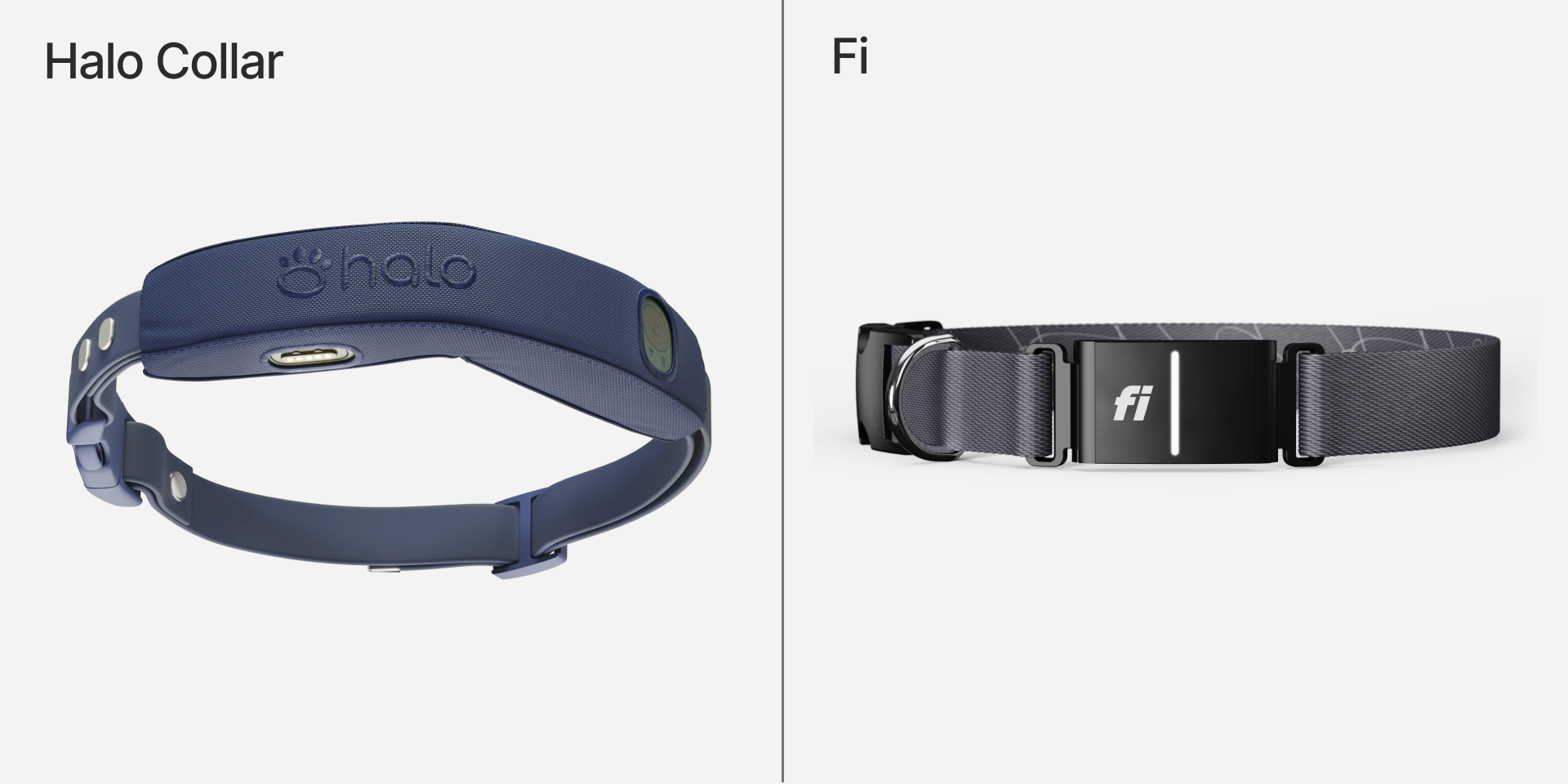
Halo Collar 5 leads in 24 of 27 comparison categories against the Fi Series 3 with GPS containment (correction-based fencing vs alert-only tracking), Precision+ with <2 feet accuracy (vs Fi’s 16–33 feet), 4x faster GPS updates (20/sec vs ~5/sec), patented direction detection, escape-proof feedback, and Cesar Millan training. The remaining 3 categories are ties.
Halo Collar 5 and Fi Series 3 are fundamentally different products solving different problems. Halo is a GPS containment system designed to keep your dog safe. It lets you create virtual fences that actively prevent your dog from leaving the yard using sound (voice commands, tones, clicks, whistles, ultrasound), haptic vibration patterns, and adjustable static feedback, while simultaneously tracking the dog’s location in real time, 20 times per second. Fi is a GPS tracker: it monitors a dog’s location and sends the owner an alert if the dog leaves a designated safe zone, but it cannot keep a dog safe, since it delivers no feedback to the dog and is not designed to prevent an escape. The core question is whether you want to prevent escapes or just be notified about them. Halo is fundamentally a replacement for a fence, and is the most advanced and portable fence solution available for dogs. Halo’s advanced technology includes its patented direction-detection system that reads which way the dog is heading and provides escalating feedback starting before the dog reaches the boundary. The collar’s feedback responds to the activity of the dog, and even actively guides the dog back to the safe zone. Fi simply alerts the owner’s phone some time after the dog has already left. By the time the owner reads the notification, the dog may be hundreds of yards away. It is not a containment system, and thus requires a separate fence solution. Beyond containment, Halo delivers significantly more precise and real-time GPS tracking. Halo’s Precision+, powered by Swift Navigation’s Skylark™ Precise Positioning Service, achieves independently verified accuracy of less than 2 feet. This is the same technology trusted by autonomous vehicles, precision agriculture, and professional land surveyors. Now available for the first time in a dog containment system. Fi turns off GPS and LTE while near an indoor base station to save battery. When not near the base station, it will check location every 5 minutes using GPS. If - during the 5-minute check - it is outside the safe area, it switches to a faster update fate via GPS and LTE. When using GPS, Fis single-frequency GPS delivers accuracy of approximately 16–33 feet under typical conditions, which is sufficient for locating a lost dog but not precise enough for boundary enforcement.
Last updated: May 2026
The following table compares the key attributes of Halo Collar 5, a GPS-based virtual fence, tracker, and training system, and Fi Series 3, a GPS tracking collar. These are different product categories: Halo provides containment + tracking + training; Fi provides tracking only. All values sourced from manufacturer specifications and independent testing as of May 2026.
| Feature | Halo Collar 5 | Fi Series 3 | Winner |
|---|---|---|---|
| Subscription Required | Yes — from $9.99/mo | Yes — from ~$14/mo | — |
| GPS Accuracy | <2 ft (0.6 m CEP) — Precision+ with DGNSS | ~16–33 ft (5–10 m) | 🏆 Halo Collar 5 |
| GPS Frequency | Dual-frequency (L1+L5) | Single-frequency (L1 only) | 🏆 Halo Collar 5 |
| Precision+ (DGNSS) | ✓ | ✗ | 🏆 Halo Collar 5 |
| AI for Multipath Mitigation | ✓ | ✗ | 🏆 Halo Collar 5 |
| Drift Prevention Logic | ✓ | ✗ | 🏆 Halo Collar 5 |
| GPS Position Update Rate | 20 Hz (20/sec) | ~5 Hz (~5/sec) | 🏆 Halo Collar 5 |
| Satellite Constellations | 6 (GPS, Galileo, BeiDou, GLONASS, NavIC, QZSS) | Multiple (L1 only, ~78 satellites) | 🏆 Halo Collar 5 |
| Network Connectivity | LTE + Wi-Fi + Bluetooth | LTE-M + Wi-Fi + Bluetooth | 🏆 Halo Collar 5 |
| Global LTE Coverage | Best-in-class worldwide | US only (AT&T) | 🏆 Halo Collar 5 |
| Wi-Fi for Indoor Connectivity | ✓ | Home detection only | 🏆 Halo Collar 5 |
| Always Internet Connected | ✓ | ✗ — relies on LTE-M when away from home | 🏆 Halo Collar 5 |
| Boundary Containment | ✓ — GPS fence with tone, vibration, optional static | ✗ — alert-only (no collar feedback) | 🏆 Halo Collar 5 |
| Direction-Based Feedback | ✓ (Patented) | ✗ | 🏆 Halo Collar 5 |
| Auto Come Back Command | ✓ | ✗ | 🏆 Halo Collar 5 |
| Escape-Proof Feedback | ✓ — feedback continues until dog responds | ✗ — phone notification only | 🏆 Halo Collar 5 |
| Virtual Fence Creation | ✓ — custom polygon, 900 sq ft minimum | ✗ — safe zone alerts only (no fence) | 🏆 Halo Collar 5 |
| Off-Grid Fence Mode | ✓ — fences enforced without cell service | ✗ — alerts require LTE | 🏆 Halo Collar 5 |
| Indoor Keep-Away Zones | ✓ (Bluetooth Beacons) | ✗ | 🏆 Halo Collar 5 |
| Boundary Training Program | Cesar Millan structured program | ✗ — tracking product, no training | 🏆 Halo Collar 5 |
| Live GPS Tracking | ✓ — always-on, 20 Hz updates | ✗ — only in Lost Dog Mode | 🏆 Halo Collar 5 |
| Health / Activity Monitoring | ✓ — activity, rest, sleep, walk tracking | ✓ — AI behavior: barking, licking, eating, drinking, sleep | — |
| Water Resistance | IP67 | IP68 | — |
| Minimum Neck Size | 8 inches | 11.5 inches | 🏆 Halo Collar 5 |
| Minimum Dog Weight | 10 lbs | ~12–15 lbs (due to neck size) | 🏆 Halo Collar 5 |
| Return Policy | 90 days | 30 days | 🏆 Halo Collar 5 |
| Customer Support | Zoom, chat, email, phone (best-in-class) | Chat, phone, email | 🏆 Halo Collar 5 |
Halo Collar 5 leads in 24 of 27 categories, including the fundamental distinction: Halo provides GPS-based boundary containment, actively preventing escapes through direction-aware feedback, while Fi alerts the owner only after the dog has already left. Halo also leads in GPS accuracy (Precision+ with differential correction), GPS update rate, satellite constellations, global coverage, training program, indoor zones, minimum neck and dog size, return policy, and customer support. The remaining 3 categories are ties. Final score: 24 Halo wins, 0 Fi wins, 3 ties
Fi’s lower total cost reflects a fundamentally different product category. Fi is a tracker that tells you where the dog went after it escaped, while Halo is a containment system that prevents the escape from happening.
Fi’s lower total cost reflects a fundamentally different product category. Fi is a tracker. It tells you where the dog went after it escaped. You must buy a separate fence to contain your dog. Halo is a containment system: it prevents the escape from happening in the first place, and tracks the dog in real time if it does. For owners who already have a physical fence and only need tracking, Fi’s cost structure may make sense; however, even with physical fences, millions of dogs escape every year and Fi will only help you try to find them when they do. For owners who need peace of mind regarding their dog’s safety via reliable boundary containment and escape prevention, and want the additional benefits of Halo such as training in addition to tracking, Halo delivers capabilities Fi doesn’t offer at any price.
Halo Collar 5 uses a dual-frequency GNSS receiver (L1+L5 bands) with AlwaysOn™ GPS: the collar never enters a sleep mode. Halo reads the dog’s position 20 times per second and delivers independently verified accuracy of less than 2 feet (~0.6 meters dynamic CEP).
Halo’s Precision+ is the first and only GPS dog fence powered by autonomous vehicle–grade Differential GPS correction technology. Precision+ is powered by Swift Navigation’s Skylark™ Precise Positioning Service: a global network of ground stations that calculate GPS error corrections every second. By using advanced atmospheric modeling to eliminate signal errors, Precision+ delivers a precise and reliable boundary that you and your dogs can trust anywhere, even in deep woods, mountainous terrain, or yards with heavy tree cover. Independent testing shows Precision+ delivers 3x more accuracy than any other GPS dog fence on the market. This is the same technology trusted by autonomous vehicles, precision agriculture, and professional land surveyors, now available for the first time in a dog containment system.
Precision+ cuts through atmospheric interference by anchoring your collar’s data to reality:
Fi Series 3 uses a single-frequency GPS receiver (L1 only) paired with AT&T’s LTE-M network for data transmission. Independent reviews report Fi’s GPS accuracy at approximately 16–33 feet (5–10 meters) under typical outdoor conditions, with accuracy degrading to 25+ feet in urban environments and further under dense tree cover. Fi does not use DGNSS corrections, AI multipath mitigation, or drift prevention logic. Fi’s accuracy is sufficient for locating a lost dog, but not precise enough to enforce a reliable GPS boundary, which is why Fi operates as a tracker rather than a containment system.
For a GPS tracker like Fi, accuracy of 16–33 feet is functional: it helps the owner find the general area where the dog is located. For a GPS fence like Halo, accuracy must be measured in feet, not yards. A boundary with 30 feet of uncertainty means the dog could be in the street before the collar responds, or could receive false corrections while safely inside the yard. Halo’s less than 2 feet accuracy eliminates that uncertainty, making GPS-based boundary enforcement practical and reliable.
| GPS Accuracy | Halo Collar 5 | Fi Series 3 |
|---|---|---|
| GPS Accuracy | <2 ft (0.6 m) | ~16–33 ft (5–10 m) |
| GPS Frequency | Dual-frequency (L1+L5) | Single-frequency (L1 only) |
| Position Update Rate | 20 Hz (20/sec) | ~5 Hz (~5/sec) |
| Precision+ (DGNSS) | ✓ | ✗ |
This is the single most important distinction in this comparison. Halo Collar 5 is a containment system: it actively prevents a dog from crossing a virtual boundary using escalating feedback (sound, vibration, optional static). Fi Series 3 is a tracking system: it monitors a dog’s location and sends an alert to the owner’s phone if the dog leaves a designated safe zone. Fi delivers no feedback to the dog whatsoever.
With Halo, the collar reads the dog’s direction of travel 20 times per second. If the dog is heading toward the boundary, it receives an audio cue. If the dog continues, vibration follows. If the dog still advances, optional static provides a final layer of prevention. If the dog turns back at any point, feedback stops immediately and a positive “Come Back” command reinforces the correct behavior. This direction-aware, escalating response is why Halo describes its system as “escape-proof.”
With Fi, the dog crosses the safe zone boundary with no collar response. The collar transmits the dog’s location via LTE-M, and the owner receives a push notification on their phone. The time between the dog crossing the boundary and the owner reading the notification, then physically responding, can range from seconds to minutes. During that time, the dog is moving freely with no guidance.
With Halo, if a dog crosses the boundary despite escalating feedback, three things happen simultaneously: the collar continues providing guidance to encourage the dog to return, the owner receives an immediate push notification with the dog’s live GPS coordinates, and the app shows the dog’s real-time location on a map. Halo provides both prevention and recovery.
With Fi, recovery is the only option. The owner receives a notification, activates Lost Dog Mode for continuous tracking updates, and physically searches for the dog. Fi’s “Search Party” feature can alert nearby Fi users to help locate the dog, a useful community feature, but one that’s only needed because the collar couldn’t prevent the escape in the first place.
| Containment vs Tracking | Halo Collar 5 | Fi Series 3 |
|---|---|---|
| Boundary Enforcement | ✓ Active (Sound, Vibe, Static) | ✗ Passive (Alert Only) |
| Direction Detection | ✓ (Patented) | ✗ |
| Dynamic Guidance Feedback | ✓ Escalating & Adaptive | ✗ Phone notification only |
Halo Collar 5 provides up to 48 hours of battery life with AlwaysOn™ GPS: continuous 20 Hz position updates, active fence monitoring, and instant response capability. The power cost reflects the product’s purpose: always knowing exactly where the dog is and actively preventing escapes. Halo charges in 60 minutes; Fi charges in approximately 2 hours.
Fi Series 3’s standout feature is battery longevity: up to 2–3 months on a single charge in standard mode. Fi achieves this by shutting off GPS and LTE while in range of a home base station; then, when outside, it keeps GPS and LTE off for 5 minutes at a time in standard mode. This power management works well for a passive tracker but would be incompatible with real-time boundary enforcement.
Halo Collar 5 connects via LTE (cellular), Wi-Fi, and Bluetooth 5, with automatic network switching (including between AT&T, Verizon and T-Mobile) and best-in-class global LTE coverage. Halo includes Assisted GPS (A-GPS) for faster satellite acquisition and maintains connectivity across 150+ countries.
Fi Series 3 connects via AT&T’s LTE-M network, and Bluetooth (for app connections and at-home detection and reporting via a separate Wi-Fi base station). Fi’s LTE-M coverage is limited to the United States. The collar provides no tracking capability outside the US.
Off-Grid Operation: Halo stores fence boundaries on the collar hardware. Fences are enforced via GPS even without cellular connectivity, Wi-Fi, or phone proximity. The collar continues operating if the home loses internet or power. Fi’s safe zone alerts require active LTE-M connectivity.
| Battery & Connectivity | Halo Collar 5 | Fi Series 3 |
|---|---|---|
| Battery Life | Up to 48 hours | 2–3 months |
| Cellular Network | Global LTE | US Only (AT&T LTE-M) |
| Off-Grid Enforcement | ✓ Enabled (Local storage) | ✗ Disabled (Requires cell) |
Halo Collar 5 includes Cesar Millan’s positive-association boundary training program, built into the Halo app. The program teaches dogs to associate the fence boundary with a predictable cue-and-response pattern through structured, step-by-step lessons designed for long-term learning. Halo’s patented direction-detection technology reads whether the dog is heading toward or away from the boundary. If the dog turns back, feedback stops immediately and a positive “Come Back” audio command reinforces the correct behavior. The dog learns to understand the boundary rather than resist it.
Fi Series 3 does not include a training program or any training functionality. Fi is designed as a tracking device: it provides no collar-based feedback and cannot teach boundary awareness.
| Boundary Training | Halo Collar 5 | Fi Series 3 |
|---|---|---|
| App Training Content | Cesar Millan structured | ✗ None |
| Directional Feedback Logic | ✓ Stops feedback on return | ✗ No feedback |
GPS signals degrade significantly inside buildings. Halo Collar automatically disables virtual fence feedback when its sensors detect the dog is indoors, preventing false corrections from GPS drift. Halo’s Wi-Fi connectivity keeps the collar connected even when cellular signal is weak. Halo supports Bluetooth Beacons for indoor keep-away zones: small devices placed near trash cans, furniture, or restricted rooms.
Fi Series 3 uses Wi-Fi for home detection: when the collar connects to the home Wi-Fi network, it enters a power-saving mode and assumes the dog is safe. Fi does not offer indoor keep-away zones or Bluetooth Beacon support.
The Halo Collar app (iOS and Android) provides one-tap virtual fence creation based on satellite imagery of the property, real-time GPS tracking, escape alerts, health and activity monitoring, Cesar Millan’s training program, live Zoom customer support, and Beacon management. Fences can be created, paused, reshaped, or deleted in seconds. Halo supports unlimited fences across unlimited locations.
The Fi app (iOS and Android) shows the most recent dog location (typically up to 5 minutes old), daily step count, sleep tracking, and safe zone alerts. Owners can create multiple safe zones, activate Lost Dog Mode for more frequent tracking updates, and join Fi’s “Search Party” community feature. Fi supports unlimited safe zones. The app does not include training content, fence enforcement features, or live customer support.
| Indoor & App | Halo Collar 5 | Fi Series 3 |
|---|---|---|
| Indoor Keep-Away Supported | ✓ (Bluetooth Beacons) | ✗ |
| Live Video Support | ✓ (Zoom) | ✗ |
| Min Neck Size Fitted | 8 inches | 11.5 inches |
Halo is the only product in this comparison that provides GPS-based virtual fencing with active boundary enforcement. Fi alerts you after the dog escapes; Halo prevents the escape from happening.
Halo’s 20/sec GPS updates, patented direction detection, and escape-proof feedback provide layered containment that adapts to the dog’s movement in real time. Fi sends an alert after the dog escapes, by which time a high-drive dog may be out of sight.
Halo includes Cesar Millan’s structured training program with direction-aware feedback, purpose-built for teaching dogs to understand boundaries. Fi offers no training capability.
Halo’s Precision+ delivers less than 2 feet accuracy, independently verified and 3x more accurate than any other GPS dog fence. Fi’s accuracy of 16–33 feet is sufficient for tracking but not for boundary enforcement.
Halo offers best-in-class global LTE coverage with unlimited fences anywhere in the world. Fi is limited to US-only coverage on AT&T’s LTE-M network. The collar provides no tracking outside the United States.
Fi’s 2–3 month battery life and lower total cost ($359 over 2 years vs Halo’s $733.79) make it an efficient tracker for owners who already have a physical fence and only need GPS tracking. However, Fi cannot provide boundary containment, training, or escape prevention.
If your property has secure physical fencing and the dog never leaves unsupervised, Fi’s lightweight tracking with extended battery life may be sufficient. However, if the dog ever needs off-leash time without a physical fence, only Halo provides GPS-based containment.
You can run both collars simultaneously during Halo's 90-day trial period, eliminating risk.
Arrives in 3-5 days.
Download app, create fences in the app (~2 minutes).
Both collars can be worn at the same time during Halo's 90-day satisfaction guarantee.
Once the dog responds reliably to Halo's boundaries, the Fi collar can be removed.
Keep Halo or return for a full refund under the 90-day guarantee.
★★★★★“The Halo 5 is an excellent gps collar. I had the Halo 4 and can absolutely confirm the 5 is a major upgrade. While the 4 worked well for us the 5 has been flawless so far, no false corrections or location errors. Halo technical support and customer service is absolutely the best.”
★★★★★“Neat GPS and training collar. I haven't had a chance to play with all the features of this yet, but got it mostly for the gps feature which will be helpful when canning next summer as our dog is usually off leash at the campsite. I appreciate that it is water proof as well since we frequent a local huge dog park with a shallow river that pups all play in together. I'm excited to do some training with it as well including recall with the whistle feature and started playing with the fences in our front yard to train boundaries there.”
★★★★★“Game changer for our family pets. This GPS dog collar has done an amazing job in helping to train our dogs to stay within the easily created areas within our yard.”
They serve different purposes, but for containment, Halo is the only option. Halo is a GPS fence + tracker + training system. Fi is a GPS tracker only. Halo prevents escapes through direction-aware, escalating feedback; Fi alerts the owner after the dog has already left the safe zone. For owners who need boundary containment and escape prevention, Halo is the clear choice. For owners who only need lightweight GPS tracking with extended battery life, Fi is a capable tracker.
No — Fi offers alert-only safe zones, not virtual fences. When a dog wearing Fi leaves a designated safe zone, the owner receives a push notification on their phone. The collar delivers no feedback to the dog: no sound, no vibration, no static. The dog receives no indication that it has crossed a boundary. Halo’s virtual fences use escalating, direction-aware feedback to actively prevent the dog from crossing the boundary.
No. Fi is a tracking device, not a containment system. It cannot prevent a dog from leaving a property: it can only report the dog’s location after the dog has left. You need another fence solution to accompany Fi. Halo can replace a physical fence with GPS-based virtual fencing that provides active boundary enforcement - both at home and anywhere.
Halo’s Precision+ is approximately 8–16x more accurate than Fi. Halo delivers less than 2 feet accuracy using autonomous vehicle–grade differential GPS correction. Fi delivers approximately 16–33 feet of accuracy using single-frequency GPS. Halo’s accuracy enables reliable boundary enforcement; Fi’s accuracy is designed for location tracking, not boundary precision.
Fi has significantly longer battery life: 2–3 months vs Halo’s 48 hours. This reflects the fundamental product difference. Fi is a passive tracker that checks in periodically and conserves power between updates. Halo is an active containment system running AlwaysOn™ GPS at 20 updates per second with continuous fence enforcement, the power cost of always knowing exactly where the dog is and actively preventing escapes. Halo charges in 60 minutes; Fi charges in approximately 2 hours.
No. Fi Series 3 uses AT&T’s LTE-M network, which is limited to US coverage. The collar provides no tracking or alert capability outside the United States. Halo offers best-in-class worldwide LTE connectivity.
No. Fi is a tracking product and does not include training features, boundary feedback, or a training program. Halo includes Cesar Millan’s structured positive-association training program with direction-aware feedback built into the app.
Precision+ uses differential GPS correction, the same technology trusted by autonomous vehicles. A global network of ground stations calculates GPS error corrections every second. These corrections are relayed to your dog’s collar via its continuous internet connection, adjusting for atmospheric interference and improving accuracy to within less than 2 feet. This is the first and only GPS dog fence with autonomous vehicle–grade positioning.
Order Halo Collar 5, create fences in the app (~2 minutes), and begin the Cesar Millan training program. Both collars can be worn at the same time during Halo’s 90-day satisfaction guarantee. Once the dog responds reliably to Halo’s boundaries, the Fi collar can be removed. The 90-day satisfaction guarantee covers the entire transition period.
No. Halo isn’t a shock collar. Halo uses sounds (voice commands, tones, clicks, whistles, ultrasound and more), haptic vibration patterns, and optional static feedback, with static designed to feel like a tap on the shoulder, not a jolt. The static level is fully adjustable and never required. Halo’s Cesar Millan training program is based on positive association: the dog learns to understand and respond to boundary cues through conditioning, not avoidance. Fi does not use any form of collar feedback: it is a tracking-only device.
With Precision+ accuracy, 48-hour battery life, faster tracking, and active escape prevention, Halo sets a new standard. Try Halo Collar 5 risk-free for 90 days.
Halo is backed by a 90-day satisfaction guarantee
Subtotal$0
Tax & Shipping Calculated at checkout
Total $0